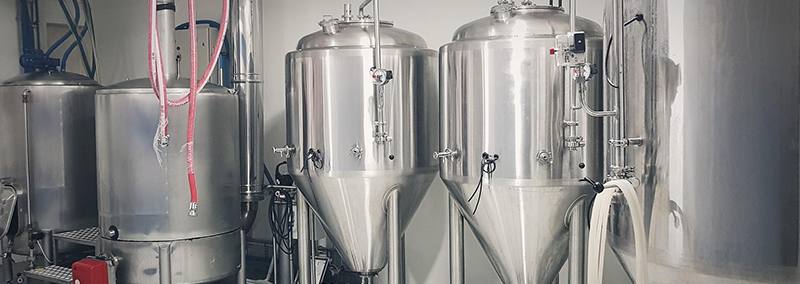
Long-term craft beer equipment maintenance depends on cleaning chemistry, inspection frequency, water quality, seal condition, temperature control, and accurate operating records. A useful program checks product-contact parts after each production cycle, inspects pumps and valves weekly, verifies sensors on a fixed schedule, and records heating and cooling times so gradual performance loss is visible. Brewers Association guidance for draught systems uses 2–3% caustic solution at 80–110°F, with at least 15 minutes of recirculation, showing why concentration, temperature, time, and flow must be controlled together. Stainless steel can last for decades, but poor chemical use, chloride exposure, damaged gaskets, scale, and neglected pumps can shorten service life considerably.
Most brewery equipment does not move directly from normal operation to complete failure. Wear usually develops through repeated heat cycles, chemical exposure, pressure changes, mineral deposits, vibration, and contact with wort or beer. A brewhouse producing five batches per week can put more than 250 production cycles on pumps, valves, heating surfaces, and transfer fittings in one year, so small changes become easier to detect when operators record them rather than relying on memory.
Cleaning should begin soon after wort, yeast, or beer leaves the equipment because dried protein and hop material take more chemical and mechanical work to remove. Cleaning-in-place performance depends on four connected variables: detergent concentration, temperature, contact time, and mechanical flow. In 2026, Brewers Association guidance for draught cleaning still recommends a 14-day cleaning interval, giving breweries a useful example of how fixed sanitation schedules are preferable to cleaning only when deposits become visible.
More chemical is not automatically more effective. Once concentration moves outside the chemical supplier's operating range, the brewery may spend more money while increasing corrosion risk, elastomer wear, rinsing time, and worker exposure.
For beer lines, Brewers Association technical guidance specifies at least 2% caustic solution, with 3% used for older or heavily soiled systems. Water should normally be around 80–110°F, recirculating solution should remain in contact for at least 15 minutes, and static cleaning needs at least 20 minutes. Those numbers should not be copied blindly to tanks or brewhouse vessels, but they show why operators need measured concentrations rather than an estimated amount poured from a container.
A tank can look bright after rinsing and still contain soil around valve seats, sample ports, thermowells, spray devices, manways, and gasket grooves. Operators should examine the same locations repeatedly after CIP, because recurring residue often points to poor spray coverage or insufficient circulation rather than weak detergent. A 2025 Brewers Association draught-cleaning presentation also specifies quarterly acid treatment and six-month servicing of couplers and foam-on-beer devices, showing how organic and mineral deposits require different maintenance intervals.
| Area checked | Useful maintenance observation | Common response |
|---|---|---|
| Tank wall | Film, scale, discoloration or pitting | Review chemistry and water quality |
| Spray device | Blocked holes or weak rotation | Clean and verify flow |
| Gasket | Flattening, cracks or swelling | Replace with compatible material |
| Valve | Resistance, leakage or residue | Disassemble and inspect |
| Pump | Noise, heat, leakage or vibration | Check seal, inlet and bearings |
| Heat exchanger | Longer cooling time | Check fouling and coolant flow |
Stainless steel deserves particular care because corrosion resistance depends on surface condition and the process environment. 304 and 316-series stainless steels are common in beverage equipment, but neither material should be treated as chemically indestructible. Chloride-rich cleaners, prolonged chemical contact, abrasive carbon-steel tools, damaged weld areas, and deposits held against the surface can increase localized corrosion risk.
Where brewery staff see brown staining, pitting, rough weld areas, or repeated deposits, scrubbing harder is a poor long-term response. The cause may be chemical concentration, chloride exposure, contaminated cleaning tools, unsuitable water, or a damaged passive surface. After fabrication or repair, professional cleaning or passivation may be appropriate when recommended by the equipment manufacturer or stainless-steel specialist.
The next wear point is usually elastomer rather than stainless steel. EPDM, silicone, FKM and other gasket materials respond differently to temperature, alcohol, acids, alkaline cleaners, compression, and steam. A brewery making 250 batches annually may open certain tri-clamp joints hundreds of times, and each removal can stretch, cut, twist, or permanently compress a gasket.
Replace a gasket when it shows cracking, swelling, permanent flattening, cuts, loss of elasticity, or a poor fit between sanitary ferrules. Replacement by calendar alone is less useful than combining service time with inspection history, because a gasket opened twice a year experiences a different mechanical history from one removed twice per day.
A gasket costing only a few dollars can hold several hundred or several thousand liters of product behind it, so replacement stock should be based on downtime risk rather than component price.
Pumps need similar attention because gradual wear often appears before total failure. Record abnormal noise, vibration, seal leakage, motor temperature, transfer time, and changes in flow. If a transfer that normally takes 18 minutes begins taking 24 minutes under the same conditions, the 33% increase deserves inspection of suction restrictions, impeller condition, air entry, valve position, seal condition, and process viscosity.
Dry running should be avoided unless the pump design explicitly permits it. Centrifugal pumps depend on correct inlet conditions, and poor suction can cause cavitation, recognized by unstable flow, vibration, and a gravel-like sound. Staff should also check whether hose collapse, blocked strainers, partially closed valves, or excessive elevation difference are restricting the pump before replacing mechanical parts.
Valves should be operated through their full intended movement and checked for leakage, unusual stiffness, loose handles, worn seats, or residue after cleaning. In high-use cellar areas, a manual valve may be operated several dozen times during one production week, so quarterly inspection alone may miss developing wear. Frequently used valves deserve visual checks during normal sanitation and more complete inspection during scheduled service.
The same approach applies to equipment purchased from suppliers such as hem brewing: maintenance instructions should follow the actual pump, valve, tank, heating, cooling, and control components installed rather than a generic brewery checklist. Equipment pressure ratings, gasket materials, motor specifications, chemical compatibility, and replacement parts should remain attached to the equipment record for its entire operating life.
Heat exchangers benefit from performance records because internal fouling is difficult to judge visually without opening the unit. Record wort inlet temperature, wort outlet temperature, coolant inlet temperature, coolant outlet temperature where available, and total cooling time. If cooling time rises from 35 minutes to 45 minutes, performance has fallen by roughly 29% in practical production terms even when the equipment still reaches the final temperature.
Possible causes include protein deposits, mineral scale, restricted glycol flow, blocked channels, inadequate water supply, damaged plates, or gasket problems. Cleaning should match the type of deposit rather than simply increasing alkaline concentration. Acid cleaning is generally used for mineral deposits, while alkaline chemistry is better suited to many organic soils.
Heating equipment deserves similar records. A steam jacket or electric element that takes 20% longer to reach the same kettle temperature may have scale, burnt-on material, poor condensate removal, a damaged element, or reduced steam performance. Keeping one heating-time record per brew provides a simple reference without adding new sensors.
Steam systems also need planned inspection rather than repair only after a trap fails. Spirax Sarco notes that maintenance frequency depends on trap type and application and gives an example in which certain balanced-pressure trap elements may be replaced about once every three years. Manufacturers still recommend inspection based on actual system conditions rather than treating three years as a universal interval.
Cooling systems should be checked from the tank back to the chiller. Glycol concentration, pump operation, hose condition, insulation, valves, strainers, and condenser airflow all affect fermentation temperature. Glycol concentration should remain within the chiller manufacturer's stated range because unnecessary concentration increases viscosity while excessive dilution reduces freeze protection.
A practical refrigeration record can include tank setpoint, actual temperature, cooling time after transfer, glycol supply temperature, and glycol return temperature. If three fermenters reach their target normally while one consistently needs 25% longer, inspect that vessel's valve, jacket, hose circuit, insulation, and flow before assuming the chiller itself is undersized.
Measurement equipment also ages. Temperature probes, pressure gauges, pH meters, scales, refractometers, conductivity meters, and flow devices should have a verification schedule based on use and process importance. A temperature probe reading 2°F high can cause a controller to stop cooling before the liquid reaches the intended temperature even though the control system itself is functioning normally.
Calibration records should state the instrument ID, date, reference used, reading before adjustment, reading afterward, technician, and next check date. When an instrument falls outside the brewery's allowed tolerance, staff should review product made since its previous acceptable verification instead of assuming the error started on the day it was discovered.
Water quality belongs in the same maintenance file because mineral content affects kettles, heat exchangers, steam equipment, spray devices, and hot-water systems. A brewery seeing repeated white or gray deposits after only a few production cycles should review hardness and treatment performance rather than repeatedly removing the same scale.
Spare-parts planning can then be based on actual maintenance history. Keep low-cost parts that can stop production, including sanitary gaskets, pump seals, O-rings, valve seats, clamps, fuses, hoses, probes, and equipment-specific service kits. If one failed seal can stop a 20-barrel transfer, storing a spare costs much less than losing a production day while waiting for delivery.
A compact schedule works well when tasks are tied to usage:
-
After each production cycle: inspect product-contact surfaces, leaks, spray coverage, fittings, and unusual pump behavior.
-
Weekly: check frequently operated valves, pump seals, hoses, insulation, strainers, and accessible electrical enclosures for abnormal condition.
-
Monthly: review heating and cooling times, inspect less accessible sanitary parts, and compare equipment performance with previous records.
-
Every 3–6 months: service selected valves and fittings, verify instruments according to their assigned interval, inspect steam and refrigeration components, and review spare-parts stock.
-
Annually: compare 12 months of maintenance records, inspect high-use equipment in greater detail, and complete manufacturer-required servicing.
Documentation does not need complicated software. A spreadsheet containing equipment ID, date, batch count, observation, repair, replaced part, chemical concentration, calibration result, and technician name can show whether failure frequency is rising. If the same pump seal is replaced three times in 12 months, the useful question is no longer which seal to order; operating conditions, alignment, dry running, suction pressure, installation, or material compatibility need to be reviewed.
Maintenance works best when operators record small changes while equipment is still running normally. A 15% longer transfer, repeated gasket deformation, slower heating, increased cooling time, or recurring scale gives staff a measurable point for inspection before production must stop.