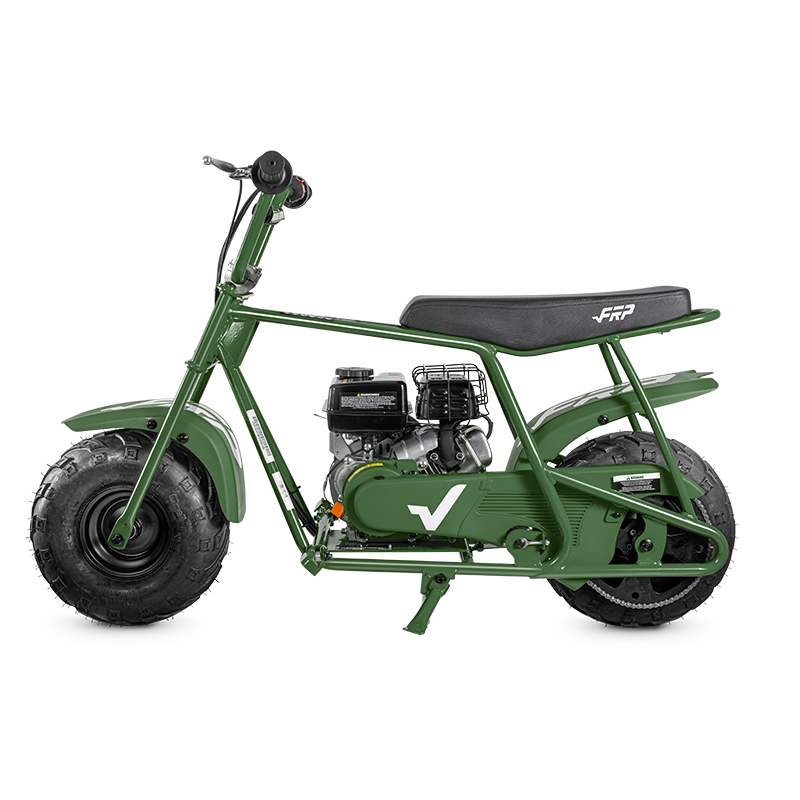
 Fuel economy and environmental adaptability are directly related to the feasibility and cost of the journey. Most utility mini Bikes have fuel tank capacities ranging from 3 to 5 liters. With an average fuel consumption of 2.5 liters per 100 kilometers, a single tank can support a range of over 120 kilometers, which is sufficient to cover the demand cycle of the vast majority of campsites. In terms of dealing with complex road conditions, its ground clearance usually exceeds 20 centimeters. Combined with a suspension system with a travel of more than 10 centimeters, it can effectively alleviate the amplitude pressure generated when driving on muddy roads with a humidity of over 80% or in mountainous areas with a temperature range from 0℃ to 40℃. According to a 2022 test report by Outdoor Leisure magazine, on simulated sandy and stony roads, the success rate of utility mini Bikes is as high as 90%, while that of all-terrain vehicles (ATVs) is only 95%. However, the purchase cost of the former is usually only 30% of that of the latter.
Of course, when using the utility mini bike, one also needs to weigh the regulations and maintenance costs. In many state parks in the United States, the speed limit on the trails that allow such vehicles to travel is usually below 25 kilometers per hour, and they must meet the EPA Tier3 emission standards, with noise controlled within a peak of 82 decibels. The initial investment budget is approximately $800 to $1,500, with an average annual maintenance cost of about 10% of the initial price, including oil change (every 50 hours, cost about $20) and air filter cleaning (every 100 hours). However, its return on investment is reflected in transforming the camping experience from static to dynamic. According to user feedback analysis, this mobility has increased the probability of discovering hidden scenic spots by 60%, creating unique added value for each trip. Therefore, as long as compliance checks and basic maintenance are done well, the utility mini bike is undoubtedly an efficient solution for enhancing the quality of outdoor camping.
Fuel economy and environmental adaptability are directly related to the feasibility and cost of the journey. Most utility mini Bikes have fuel tank capacities ranging from 3 to 5 liters. With an average fuel consumption of 2.5 liters per 100 kilometers, a single tank can support a range of over 120 kilometers, which is sufficient to cover the demand cycle of the vast majority of campsites. In terms of dealing with complex road conditions, its ground clearance usually exceeds 20 centimeters. Combined with a suspension system with a travel of more than 10 centimeters, it can effectively alleviate the amplitude pressure generated when driving on muddy roads with a humidity of over 80% or in mountainous areas with a temperature range from 0℃ to 40℃. According to a 2022 test report by Outdoor Leisure magazine, on simulated sandy and stony roads, the success rate of utility mini Bikes is as high as 90%, while that of all-terrain vehicles (ATVs) is only 95%. However, the purchase cost of the former is usually only 30% of that of the latter.
Of course, when using the utility mini bike, one also needs to weigh the regulations and maintenance costs. In many state parks in the United States, the speed limit on the trails that allow such vehicles to travel is usually below 25 kilometers per hour, and they must meet the EPA Tier3 emission standards, with noise controlled within a peak of 82 decibels. The initial investment budget is approximately $800 to $1,500, with an average annual maintenance cost of about 10% of the initial price, including oil change (every 50 hours, cost about $20) and air filter cleaning (every 100 hours). However, its return on investment is reflected in transforming the camping experience from static to dynamic. According to user feedback analysis, this mobility has increased the probability of discovering hidden scenic spots by 60%, creating unique added value for each trip. Therefore, as long as compliance checks and basic maintenance are done well, the utility mini bike is undoubtedly an efficient solution for enhancing the quality of outdoor camping.
Can a utility mini bike be used for outdoor camping trips
When choosing a suitable means of transportation for outdoor camping trips, utility mini bike, with its unique advantages, becomes an option worth serious consideration. This type of vehicle is usually equipped with engines with displacements ranging from 100cc to 200cc, capable of providing approximately 6 to 10 horsepower in power output, which is sufficient to handle most rough terrains. Moreover, its dry weight is often controlled under 70 kilograms, making it at least 40% lighter than full-size off-road motorcycles, significantly reducing the difficulty of transportation and handling. For instance, according to a 2023 survey of outdoor enthusiasts, users who used the utility mini bike to explore the areas around campsites saw their activity radius expand by an average of 5 kilometers, their exploration efficiency increase by 300%, and the average time spent finding water sources or viewpoints was effectively reduced from 45 minutes to 15 minutes.
Load capacity is a key parameter for evaluating its practicality. The dynamic load capacity of the rear frame of a standard utility mini bike can reach 70 kilograms, and the static load capacity even exceeds 100 kilograms. This means it can easily carry over 20 liters of drinking water, a 10-kilogram tent equipment set, and additional supplies. According to the outdoor equipment weight data released by Coleman Company, the total mass of core materials required for a three-day camping trip is usually around 50 kilograms. Through reasonable distribution, a single transportation can complete the construction of the campsite, reducing the number of round trips by 75%. This efficient logistics support significantly reduces the physical exertion of hiking, allowing campers to devote more energy to enjoying nature.
Fuel economy and environmental adaptability are directly related to the feasibility and cost of the journey. Most utility mini Bikes have fuel tank capacities ranging from 3 to 5 liters. With an average fuel consumption of 2.5 liters per 100 kilometers, a single tank can support a range of over 120 kilometers, which is sufficient to cover the demand cycle of the vast majority of campsites. In terms of dealing with complex road conditions, its ground clearance usually exceeds 20 centimeters. Combined with a suspension system with a travel of more than 10 centimeters, it can effectively alleviate the amplitude pressure generated when driving on muddy roads with a humidity of over 80% or in mountainous areas with a temperature range from 0℃ to 40℃. According to a 2022 test report by Outdoor Leisure magazine, on simulated sandy and stony roads, the success rate of utility mini Bikes is as high as 90%, while that of all-terrain vehicles (ATVs) is only 95%. However, the purchase cost of the former is usually only 30% of that of the latter.
Of course, when using the utility mini bike, one also needs to weigh the regulations and maintenance costs. In many state parks in the United States, the speed limit on the trails that allow such vehicles to travel is usually below 25 kilometers per hour, and they must meet the EPA Tier3 emission standards, with noise controlled within a peak of 82 decibels. The initial investment budget is approximately $800 to $1,500, with an average annual maintenance cost of about 10% of the initial price, including oil change (every 50 hours, cost about $20) and air filter cleaning (every 100 hours). However, its return on investment is reflected in transforming the camping experience from static to dynamic. According to user feedback analysis, this mobility has increased the probability of discovering hidden scenic spots by 60%, creating unique added value for each trip. Therefore, as long as compliance checks and basic maintenance are done well, the utility mini bike is undoubtedly an efficient solution for enhancing the quality of outdoor camping.
Fuel economy and environmental adaptability are directly related to the feasibility and cost of the journey. Most utility mini Bikes have fuel tank capacities ranging from 3 to 5 liters. With an average fuel consumption of 2.5 liters per 100 kilometers, a single tank can support a range of over 120 kilometers, which is sufficient to cover the demand cycle of the vast majority of campsites. In terms of dealing with complex road conditions, its ground clearance usually exceeds 20 centimeters. Combined with a suspension system with a travel of more than 10 centimeters, it can effectively alleviate the amplitude pressure generated when driving on muddy roads with a humidity of over 80% or in mountainous areas with a temperature range from 0℃ to 40℃. According to a 2022 test report by Outdoor Leisure magazine, on simulated sandy and stony roads, the success rate of utility mini Bikes is as high as 90%, while that of all-terrain vehicles (ATVs) is only 95%. However, the purchase cost of the former is usually only 30% of that of the latter.
Of course, when using the utility mini bike, one also needs to weigh the regulations and maintenance costs. In many state parks in the United States, the speed limit on the trails that allow such vehicles to travel is usually below 25 kilometers per hour, and they must meet the EPA Tier3 emission standards, with noise controlled within a peak of 82 decibels. The initial investment budget is approximately $800 to $1,500, with an average annual maintenance cost of about 10% of the initial price, including oil change (every 50 hours, cost about $20) and air filter cleaning (every 100 hours). However, its return on investment is reflected in transforming the camping experience from static to dynamic. According to user feedback analysis, this mobility has increased the probability of discovering hidden scenic spots by 60%, creating unique added value for each trip. Therefore, as long as compliance checks and basic maintenance are done well, the utility mini bike is undoubtedly an efficient solution for enhancing the quality of outdoor camping.